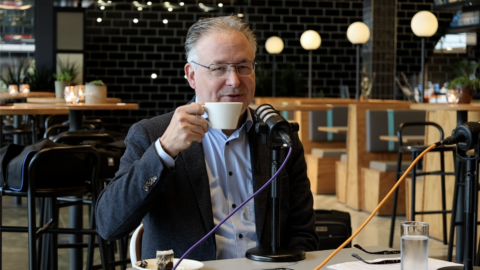
Bert Strijker is one of the driving forces behind the Lage Weide energy hub in Utrecht, which was grandly launched a year ago. What drives him and what does he see as his role?
In Utrecht, one of the first energy hubs in the Netherlands was set up last year. Participating companies coordinate the generation and consumption of energy with each other, thus absorbing each other's peaks. Setting up the hub had many pitfalls and pitfalls, but now it is time to scale up, says Bert Strijker. His motto? You can talk and research, but if you really want to make a difference, you just have to start somewhere. "Take it one step at a time, and then see where you end up."
Collaborate
Bert has been active in the field of sustainability of business parks for years. For example, he did a project in which a digital twin was made for congestion management and power balancing of a business park on Lage Weide. In that model, they placed a large battery. "We wanted to see what you could do next to distribute that power better. That's where I learned that grid congestion is a problem, but that you can do something about it by controlling it." He wanted to impart that knowledge. Everywhere he subsequently went to talk about security of supply and affordability it seemed like they heard it thunder in Cologne. "But in Lage Weide they raised their finger."
Ultimately it was about cooperation, to show that it can be doneBert Strijker
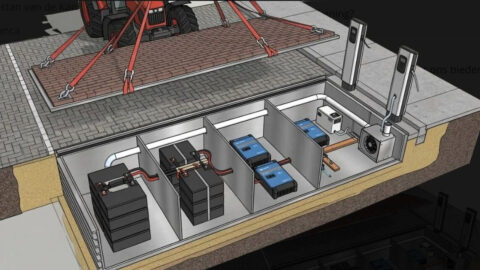
For that to happen, companies had to start working together anyway, Strijker says. "We did a feasibility study, and then we started with field 19." That's the loop of grid operator Stedin, which has five companies on it. "The first step was to set up a cooperative in which we partnered with the grid company. But we would not buy assets directly." So no battery came. "The freezer house of one of our participants acts as a kind of battery. Ultimately it was about cooperation, to show that it can be done."
Social role
This is where the credo 'step by step' came in handy. Stedin came up with an offer for group capacity of the companies collectively, which was considerably lower than the capacity of the companies together. It was therefore quite a challenge to fit the consumption there. "With EMS vendor Groendus, we profiled consumption and determined where each could scale back and where they could use each other's capacity. Despite the setback, we wanted to move forward because we wanted to take on that social role. The idealism was already pretty much there. The offer from Stedin was accepted anyway. But then we still had to arrange insurance and liability. Due to unfamiliarity in the market, this was not possible at that time, and we raised this with the Ministry of Climate and Green Growth. Finally, shortly before the signing, Tennet came and said, "You did that nicely, but we don't like it. Between 4 p.m. and 8 p.m. we can't supply everything, then the consumption has to be reduced even further.' In the end we swallowed that too, and on July 11 we then signed."
Scaling up of e-hub needed
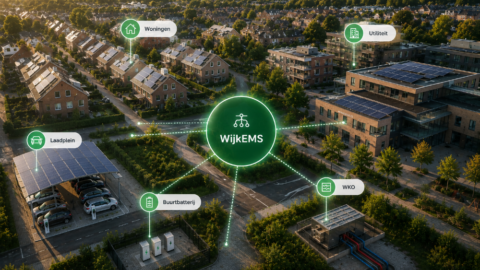
In a few months, everything was then poured into a large EMS and at the companies individually into sub-EMSes, Strijker says. "In January it really went live and the system actually started steering. Those first few months are very exciting. How is it going, are there overruns and how much money is it going to cost? Then you notice in March-April-May that things are going well. We got through that, now we can be bigger, more and better. There are five companies now, but in 2027 there could be 100! Because you have developed something that you can scale up, broaden and copy."
Despite the setback, we wanted to continue because we wanted to pick up that social roleBert Strijker
There are now talks with 21 companies, many of which have multiple connections. "And we may be ring-transcending," Strijker says. "So then we have to start optimizing per field, and also the fields among themselves. How are you going to arrange that? That hasn't been done before either. So we have to proceed very carefully. We can't make a mistake, because then part of Lage Weide will be out of business, and that won't make us popular. Quality comes before speed. At the same time, scaling up is necessary for the continuity of the cooperative."
Dreams and steps
Bert Strijker really sees the E-hub as a solution, especially if all of Lage Weide is going to participate. "And this is only the first brick," he says. "It's about sustainability, and we want to become the city's energy engine. Power then goes to the different companies and neighborhoods through the E-hub. There is exchange and we coordinate our consumption with each other. Between 4 p.m. and 8 p.m. we use a little less, in a smart way."
But looking ahead and dreaming bigger doesn't mean Strijker takes his eyes off the ball. No matter how big the goal, you always have to be working on the step you're currently taking. "Those 21 companies we're talking to now, we know them. Those are doing their own energy management and to the extent they are not doing it, they are getting advice. You shouldn't bring in companies that aren't working on it, they should be able to offer something. There have to be adjustable peaks and troughs, for example."
No matter how big the goal, you should always be working on the step you are currently takingBert Strijker
In addition, everyone must always be included in every step taken. "For example, we are now pulling together with park management Lage Weide and the municipality and the province of Utrecht. And at Stedin you have to include all layers separately. The board, the management and the innovation and implementation departments. That also means that sometimes things can't go faster than they can. It all remains human work."
At all levels
So this pioneering requires a cautious approach at all levels simultaneously. And that is precisely where Bert Strijker picks up an important role. "I am an ambassador for PVB Netherlands, with which we are trying to boost the level of organization of business parks. I also have connections with the knowledge platform energyhubs.nl. Among other things, this is a collaboration between network companies and the Ministry of Climate and Green Growth. In Utrecht, I am in Waterstof Utrecht. So I am involved in everything, at local and provincial level and on a national scale. This makes me the link that connects all levels. Because sustainability cannot be achieved from an ivory tower. If you don't get the business parks on board, you won't succeed. But you also have to know what is bothering the higher echelons. I know most of the buttons at various levels."

This is an article from Construction and Installation Hub. Want to keep up with all the news from the construction and installation industry? Then take a look at the hub and sign up for the online community.
↗