The shortage of technical personnel is forcing the construction and building services sectors to change the way they work. With the opening of the Modulekracht assembly hall in Dordrecht, Heijmans is taking the next step in the industrialization of building services work.
Not by reinventing prefabrication, but by bringing together various building services disciplines even before construction begins. According to plant manager Maarten Nijhoff, this shift is urgently needed to ensure that projects can continue to be completed in the future.
There will still be no shortage of construction projects in the coming years. But who will carry out all that work? Across the board, companies in the construction and installation sectors are grappling with this issue. For construction giant Heijmans, too, the shortage of skilled workers is already being felt, and it threatens to become even more acute due to an aging workforce. “We’re already noticing that staffing is becoming a major issue,” says Maarten Nijhoff, who has been the manager of Modulekracht since June. “You can win the projects, but how are you going to carry them out?”
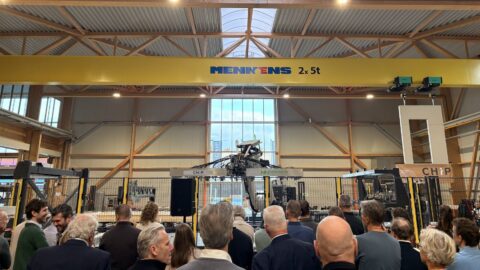
That challenge is the main reason behind the new assembly hall for installation modules in Dordrecht, which officially opened at the end of October. The hall is intended to help Heijmans maintain sufficient production capacity despite fewer available working hours.
Bringing all building services disciplines together under one roof
Prefabrication is certainly not a new phenomenon in the building services sector. Many building services companies have been assembling their piping, technical frames, and complete system components in their own workshops for years. So what does Heijmans bring to the table, and—more importantly—where is the innovation?
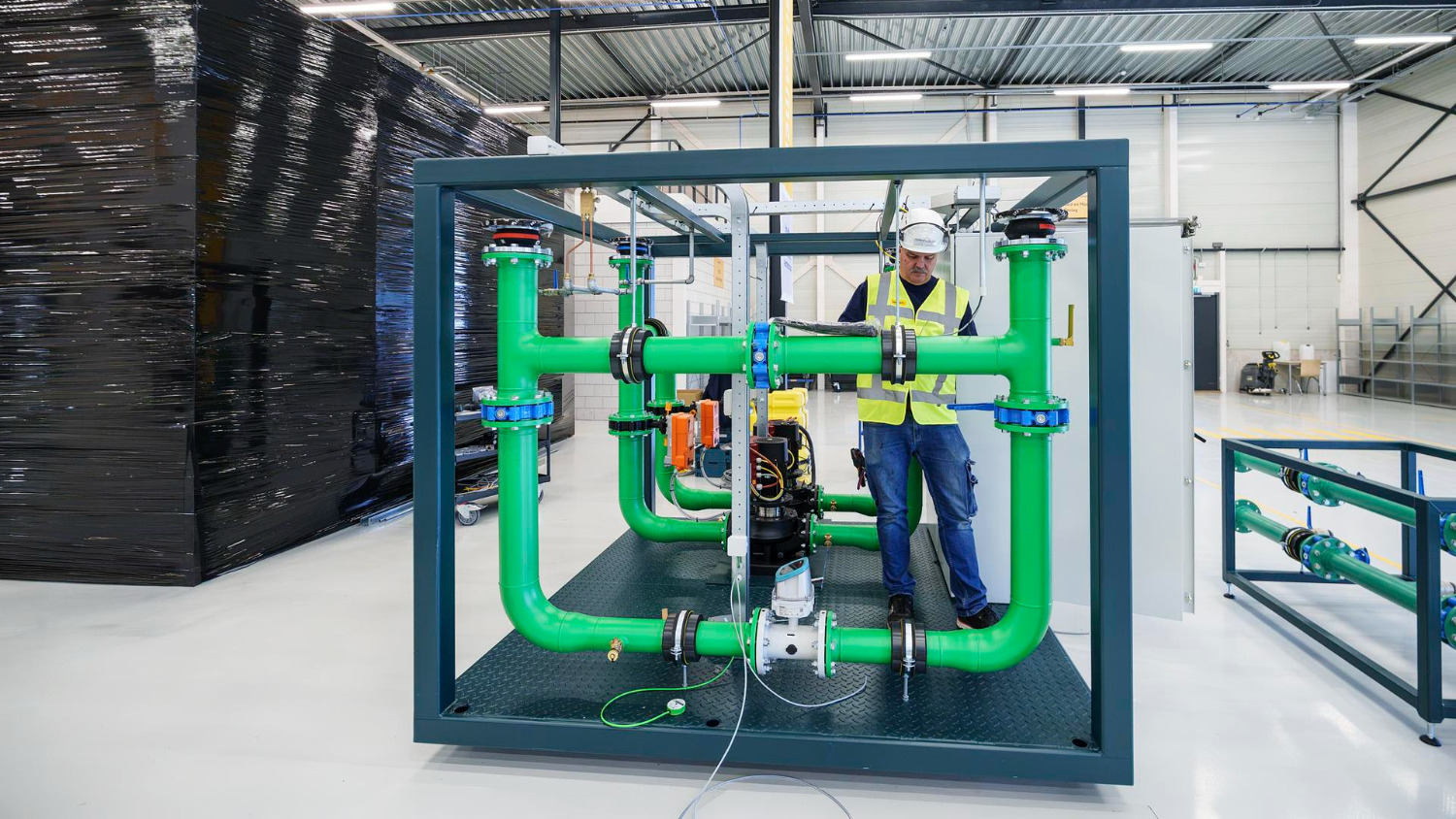
According to Nijhoff, the key difference lies in the collaboration between the various disciplines. While installers typically prefabricate their own components, Heijmans aims to assemble complete multidisciplinary modules.
One example is a corridor module for a large government office building. This module integrates, among other things, pipes for chilled water and central heating, ventilation systems, and data infrastructure. Normally, these tasks are contracted out separately and carried out on-site during the finishing phase. “That means you’re sending all those different contractors onto that busy construction site at the same time. They get in each other’s way, it’s prone to errors, and all kinds of inefficiencies arise,” Nijhoff explains.
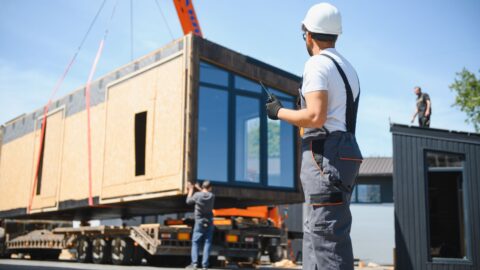
In Dordrecht, the collaborating installation companies will have their own workspace to assemble their respective parts of the module. The assembled unit is then transported to the construction site, where the module can be installed and connected all at once. According to Nijhoff, that is precisely where the strength of this concept lies. “As a single-discipline firm, we aren’t necessarily any better than a specialized installation company. But we can play a role in integrating all those different disciplines.”
A 50 percent reduction in working hours?
According to Heijmans, this approach can significantly reduce the number of assembly hours required. For the hallway module, it has been calculated that traditional on-site assembly takes about 62 work hours, compared to 30 hours for assembly in Dordrecht.
However, those substantial savings have not yet been proven in practice. Nijhoff emphasizes that this is an estimate based on cost-calculation standards and the original business case. A few prototype modules have been built, but large-scale production has yet to begin. “We actually feel it could be even faster than 30,” he says. At the same time, Nijhoff acknowledges that the ratio will vary by module type.
For Heijmans, the potential cost savings aren’t the main goal, either. Just as important is shifting labor hours from the busy construction site to a controlled production environment. This allows modules to be produced earlier, making the work less dependent on the on-site schedule.
Deploying craftsmanship in a more targeted way
In the long run, this approach also offers opportunities to deploy available technical staff differently. After all, not every assembly task requires the same specialized knowledge. “How are you going to deploy the skilled labor that will still be available as effectively as possible?” Nijhoff wonders. “The expertise of the skilled worker remains extremely important, for example, in designing the modules. But perhaps that same skilled worker no longer needs to perform all the relatively simple assembly tasks.”
Initially, the existing subcontractors will continue to carry out their own work, albeit partially at a different location. Later, Heijmans may begin working with permanent assembly teams. Nijhoff also sees opportunities here for new hires, employees in training, and older skilled workers for whom physically demanding work on the construction site is becoming less appealing.
New dynamics in the supply chain
This change does, however, require a different kind of collaboration between the general contractor and the building services contractors. As Heijmans takes on more control over the assembly process, there may also be shifts in work assignments, responsibilities, and revenue. Nijhoff emphasizes that Heijmans is committed to making this transition in close collaboration with the MEP contractors and other supply chain partners. Their knowledge and experience remain indispensable in the development and assembly of the modules. “We can’t do much without our suppliers and subcontractors. We’re really doing this together.”
The new facility is currently still in the start-up phase. The first skids will be assembled shortly, while large-scale production of corridor modules is expected to begin in late 2027. The goal is to then apply the knowledge gained to multiple projects and further standardize the modules.
For Heijmans, Modulekracht is therefore more than just a new prefab workshop. It’s an effort to structurally transform the organization of installation work. According to Nijhoff, continuing as before is ultimately not an option: “If we keep doing things the way we’ve always done them, we’re really going to run into trouble with our projects.”

This is an article from Construction and Installation Hub. Want to keep up with all the news from the construction and installation industry? Then take a look at the hub and sign up for the online community.
↗